You save three facial lymphatic drainage videos. One starts at the jaw, another starts near the collarbones, and the third introduces a gua sha tool before explaining how much pressure to use. None of them is necessarily useless, but together they leave you trying to assemble a routine on your own.
A good course should remove that uncertainty. It should organize the technique into one gentle, repeatable sequence, explain why the steps are taught in that order, and be honest about what facial massage can and cannot change.
The short answer: choose a lymphatic drainage massage course that is made specifically for facial self-massage, works with hands alone, demonstrates feather-light pressure, explains safety and contraindications, and makes modest claims. It should help you practice with confidence, not sell permanent sculpting, a medical treatment, or a drawer full of tools.
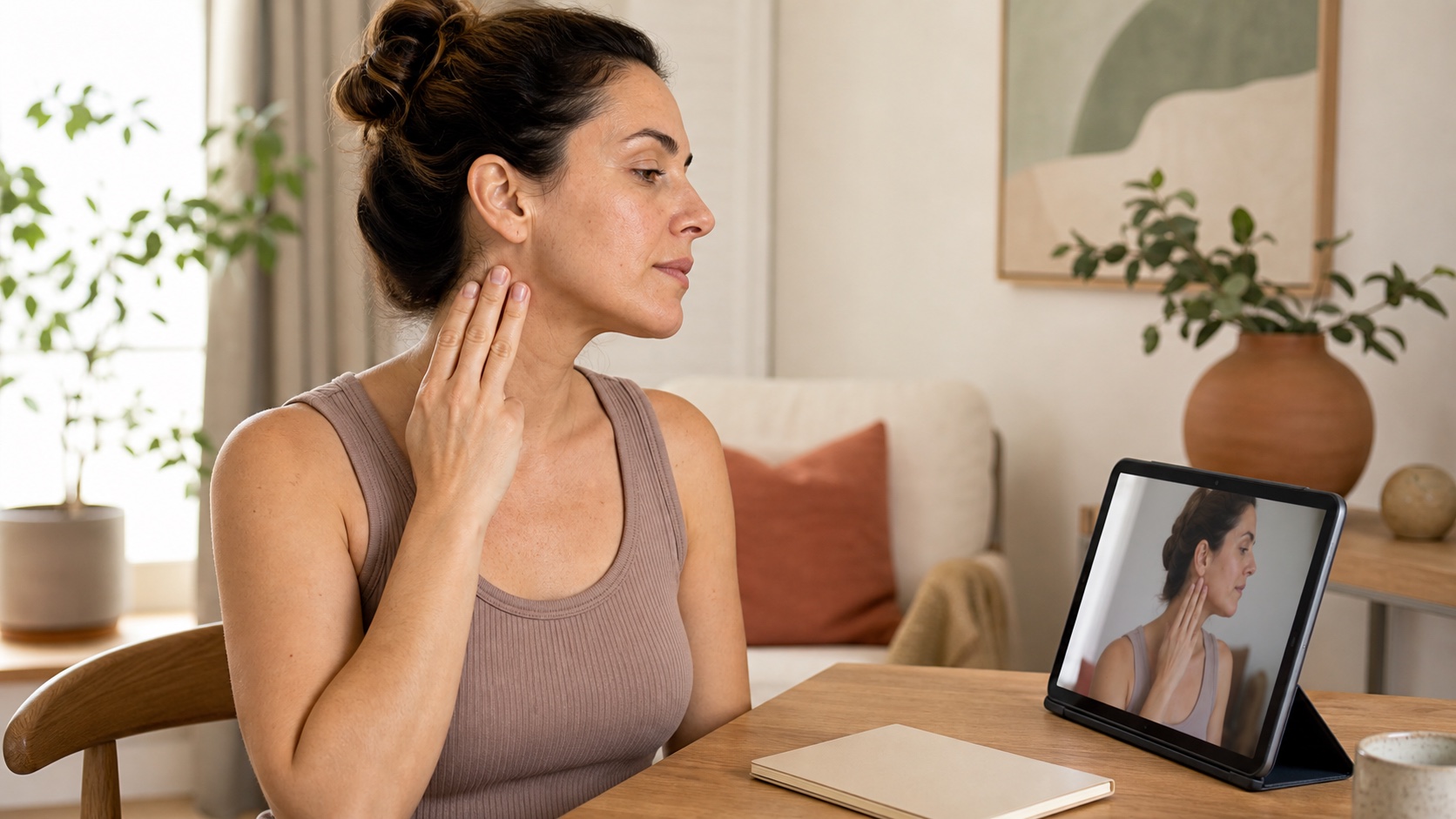
First, which kind of course are you looking for?
This guide is for someone choosing a cosmetic facial self-massage course for personal use. That is different from professional manual lymph drainage (MLD), complete decongestive therapy (CDT), or post-surgical training.
| Type of learning | Best for | What it should provide |
|---|---|---|
| Free tutorials | Exploring the technique before committing | A short routine or an explanation of one area |
| Consumer facial self-massage course | Building a gentle, repeatable routine at home | Clear demonstrations, light-pressure cues, safety boundaries, and realistic expectations |
| Professional MLD or CDT training | Eligible healthcare or massage professionals working within their scope | Anatomy, assessment, supervised skill development, contraindications, and recognized education requirements |
A short online facial course does not qualify someone to treat lymphedema or provide post-surgical care. Professional requirements also vary by location and profession. In the United States, for example, the Lymphology Association of North America requires eligible candidates to complete a 135-hour CDT course before applying for its certification exam. That is a different purpose and level of training from learning a cosmetic routine at home.
Is a paid course worth it over free videos?
Nothing about gentle facial massage needs to be treated as secret knowledge. Free videos may be enough if you can find a careful teacher, put the pieces together, and practice without second-guessing the order or pressure.
A course becomes useful when you want:
- One complete sequence. You can learn the routine from beginning to end instead of collecting separate videos for the eyes, jaw, cheeks, and neck.
- The reasoning behind the movements. Understanding why a typical healthy-anatomy routine prepares the neck and collarbone area before working on the face makes the sequence easier to remember.
- Pressure you can actually see. Lymphatic-style self-massage uses light skin-stretching movements, not deep muscle kneading. Close camera angles and spoken cues matter.
- Safety in the main lesson. Contraindications and warning signs should not be buried in a disclaimer.
- A realistic practice plan. A useful course helps you repeat a short routine without suggesting that more pressure, more time, or daily massage must produce a better result.
If a few reputable free lessons already give you that, you may not need to pay. The value of a course is structure and clarity, not access to a mysterious technique.
The 9-point course checklist
1. It is specific about who the course is for
The sales page should say whether the course is for personal facial self-care, beauty professionals, massage therapists, or clinicians. Be cautious when one short course claims to serve all four audiences. Their responsibilities and safety needs are not interchangeable.
2. Hands are enough to complete the routine
You should not have to buy a branded roller, oil, or gua sha tool just to follow the core lessons. Hands give useful sensory feedback about pressure and skin movement.
A tool can be offered as an optional cosmetic variation, but the instructor should explain how the technique changes. Gua sha should not be presented as the same thing as clinical MLD.
3. The instructor demonstrates feather-light pressure
Look for flat finger pads, slow rhythm, a small stretch and release of the skin, and no deep digging into facial muscles. A clear course should show the technique from more than one angle and tell you what excessive pressure looks or feels like.
If the routine is painful, leaves strong redness, or promises that forceful scraping produces better drainage, step away.
4. The sequence is taught as a connected route
For someone with an intact lymphatic system, facial self-massage courses commonly prepare the area around the neck and collarbones, work from the face toward the areas in front of the ears, and finish down the sides of the neck. The course should explain the route it teaches instead of giving you hand motions to copy without context.
One cosmetic sequence does not apply to every medical situation. Surgery, radiation, cancer treatment, diagnosed lymphedema, or altered lymph nodes can change the appropriate route. In those cases, follow the plan given by your healthcare team rather than a general beauty course.
5. The claims stay modest
Some people notice that mild puffiness looks temporarily softer or that their face feels more relaxed after gentle massage. Cosmetic research is limited, results vary, and a visible change may be subtle or absent.
A responsible course should not promise to remove fat, permanently sharpen a jawline, lift facial tissue, flush toxins, or treat an underlying medical condition. Temporary de-puffing is not permanent facial restructuring.
6. Safety is part of the curriculum
The course should tell you when to pause, modify the routine, or seek medical advice. At minimum, it should address broken or infected skin, active irritation, sudden or unexplained swelling, recent facial or dental procedures, diagnosed lymphatic conditions, and a history of surgery or radiation in the area.
Lymphatic drainage massage is not appropriate for everyone. Cleveland Clinic lists conditions including blood clots, cellulitis, fever, heart disease, infection, and kidney failure among reasons to avoid it or seek medical guidance. Read the full lymphatic drainage precautions and use the MyFaceRitual facial massage safety guide as a baseline.
7. The teacher's background matches the promise
For a personal cosmetic course, look for transparent education, relevant practical experience, careful sourcing, and a clear statement of scope. For professional continuing education, verify the provider and course with the body that matters for your license or jurisdiction. A generic downloadable certificate does not automatically make a course professionally recognized.
The instructor should also be comfortable saying what the course does not teach. That boundary is a sign of competence, not a weakness.
8. The format makes the technique easy to follow
Before buying, check for:
- Close views of hand placement and pressure
- Spoken guidance plus captions or a transcript
- Playback controls and lessons that work on a phone
- A concise routine summary you can use after learning the sequence
- Enough access time to revisit the lessons without an unnecessary subscription
- Clear support, cancellation, and refund terms
The best format is not necessarily the course with the most hours. It is the one you can understand, complete, and repeat safely.
9. The course helps you become less dependent on it
A well-designed beginner course should gradually make the sequence feel familiar. It may offer follow-along videos for convenience, but it should not make a simple routine feel impossible without permanent access to the instructor.
Red flags before you buy
Be cautious if a course:
- Guarantees permanent contouring, lifting, wrinkle removal, or fat loss
- Uses "detox" as a catch-all explanation without defining the claim
- Encourages painful pressure, forceful scraping, or aggressive work over swelling
- Treats gua sha or another branded tool as mandatory
- Recommends the same sequence after surgery, radiation, or lymph-node removal without individualized medical guidance
- Calls a completion certificate a clinical qualification
- Hides the curriculum, instructor background, access period, or refund terms until after payment
- Creates urgency around a technique that should feel calm and considered
Questions to ask before you sign up
- Is this specifically a facial self-massage course?
- Can I complete the entire routine with my hands?
- Will I see close demonstrations of pressure, rhythm, and direction?
- Does the curriculum cover contraindications and signs that need medical attention?
- Are the promised results temporary and realistic?
- What relevant education and experience does the instructor have?
- Is the certificate, if offered, simply proof of completion or recognized professional education?
- How long will I have access, and can I view the lessons on my usual device?
- What happens if the course is not the right fit?
You should be able to answer most of these before entering your payment details.
How MyFaceRitual is approaching the course
We are building MyFaceRitual around a simple idea: you should not need twenty disconnected videos to learn one gentle facial routine.
The planned course will teach a complete sequence step by step, explain pressure and direction rather than asking you to imitate unexplained hand movements, and make the safety boundaries clear. Clean hands will be enough for the core routine. Any tool-based variations will be optional, not an extra purchase required to begin.
The course is being designed to help you learn the sequence and use it independently, with a shorter follow-along option for days when you want guidance. If that sounds useful, join the MyFaceRitual waitlist.
Want to understand the technique before deciding whether you need a course? Start with the free complete facial lymphatic drainage massage guide.
Frequently asked questions
Is a lymphatic drainage massage course worth it over free videos?
It can be worth it if scattered tutorials leave you unsure about pressure, order, or safety. A good course provides one complete facial sequence and explains the reasoning. If careful free lessons already give you a routine you understand and use confidently, you may not need to pay.
Can you learn facial lymphatic drainage online?
You can learn a gentle cosmetic self-massage routine online when the lessons show hand placement and light pressure clearly and include safety guidance. An online consumer course is not a substitute for individualized care for lymphedema, persistent swelling, or post-surgical recovery.
Do I need a gua sha tool for a facial lymphatic drainage course?
No. A complete beginner routine should work with clean hands alone. A course may include gua sha as an optional cosmetic variation, but it should explain that tool-assisted massage is not the same as clinical manual lymph drainage.
Is an online course certificate professionally recognized?
Not automatically. A completion certificate may only confirm that you watched or passed that course. If you need continuing education or a professional credential, verify the provider, curriculum, practical requirements, and acceptance with your licensing or certifying organization before paying.
Who should avoid facial lymphatic self-massage?
Do not use a general cosmetic course to treat sudden, painful, persistent, hot, red, or one-sided swelling, active infection, unexplained enlarged lymph nodes, or swelling after a procedure. Ask your healthcare team for guidance if you have diagnosed lymphedema, altered lymph nodes, or a history of surgery, radiation, or cancer treatment in the area.
Sources and scope
This article is general education about choosing a cosmetic facial self-massage course, not individualized medical advice or professional MLD training. The safety and technique criteria were informed by facial self-massage guidance from University Health Network, medically reviewed precautions from Cleveland Clinic, professional certification requirements from LANA, and continuing-education provider information from the National Certification Board for Therapeutic Massage and Bodywork.